
Wrist Wraps: Their Effects and How to Choose Them

1. What are wrist wraps?
Wrist wraps are supporters that fix and protect your wrists (wrist joints) by wrapping around them.
They are mainly used for press-type exercises (pushing movements) to prevent the wrist from hyperextending and dramatically increase joint stability.
Many people who start weight training experience "wrist pain or discomfort" during exercises like bench press or machine chest press. If you feel such pain or discomfort, wrist wraps are the first gear you should try.

2. Why use wrist wraps in the first place?

Wrist wraps are used by many people who do weight training. They are even called one of the "three sacred treasures" of weight training.
Let's look at the fundamental reasons why so many people use wrist wraps and why they are considered essential for weight training.
① To reinforce the wrist, a "structural weakness"
The human wrist (carpal joint) has a very complex and delicate structure. While the human wrist allows for free movement, it lacks the robust stability to support heavy objects vertically.
-
Structural Instability: When gripping a 100kg barbell for a bench press, the entire weight is concentrated on the small wrist joint.
-
Role of Wrist Wraps: By wrapping the wrist, the scattered carpal bones are strongly compressed from the outside, making the "wrist like a single thick bone." This physically covers the structural weakness.
② To maximize "force transmission efficiency" (mechanical advantage)
To lift heavy weights, the power generated by the muscles must be transmitted to the barbell without loss.
-
Conditions that cause power loss: If the wrist is bent backward, the forearm bones (radius and ulna) will not be perpendicular to the weight of the barbell. At this "bend," force escapes, not only reducing the weight lifted but also increasing the burden on the wrist.
-
Forced Reset by Wrist Wraps: Wrist wraps fix the wrist in a "neutral (natural straight) position." This ensures that the palm → wrist → forearm bones are aligned, allowing the power of the pectorals and triceps to be transmitted to the bar along the shortest path.
③ To release the "limiter" of the nervous system
What is surprisingly little known is this neurological reason. When the human brain detects an unstable joint, it applies a "brake" to prevent injury, telling the muscles not to exert full force.
-
Brain's defense mechanism: If the wrist is wobbly, the brain determines that "the joint will break if more force is exerted" and subconsciously suppresses output.
-
Signal of "stability = safety": When the wrist is firmly fixed with wrist wraps, a signal is sent to the brain that "this joint is safe." As a result, the limiter is released, and muscles can exert 100% of their inherent potential.


■ Are wrist wraps necessary for beginners?
Conclusion: Wrist wraps are a training gear that beginners should definitely use.
Many beginners who are new to weight training experience discomfort or pain in their wrists sooner or later during press-type exercises like the bench press.
Instead of enduring that discomfort or pain and pushing themselves too hard, it's much more enjoyable to continue weight training by making good use of "tools" like wrist wraps.
By using wrist wraps, your wrists will be stable, your training form will be stable, and you can even expect improved output, so there's no reason not to use them from the beginning as a beginner.
Beginners often feel anxious, thinking, "Do I really need them as a beginner?" "Such serious equipment might be too much for a beginner..." or "I feel a bit embarrassed..." However, there's absolutely no need for such worries.
So, even as a beginner, please use wrist wraps to prevent injuries, continue high-quality training, and accelerate your muscle growth!
3. How to use wrist wraps
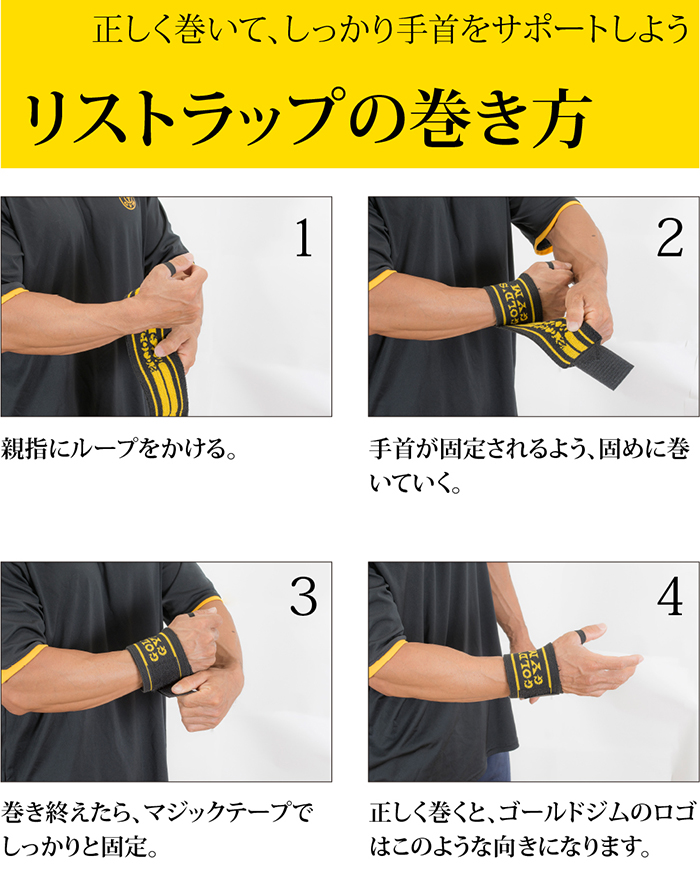
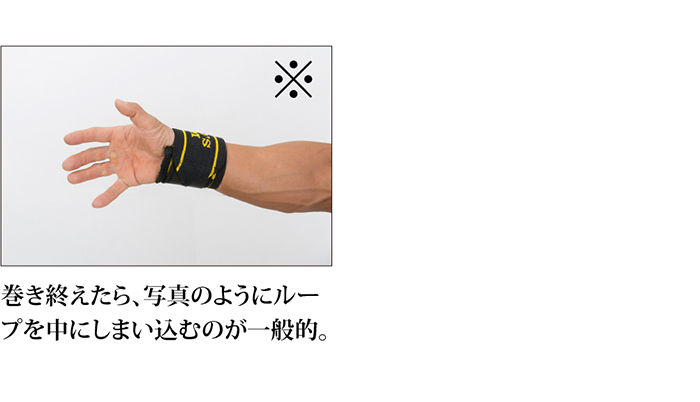
■ A slightly more technical discussion...
Should they be wrapped inwards or outwards?
Whether wrist wraps should be wrapped inwards or outwards is a very technical point, but does the wrapping direction make a difference?
In conclusion, there is no absolute correct direction for wrapping; feel free to prioritize your personal preference (i.e., what feels right).
However, the following differences might be considered depending on the wrapping direction, so it could be interesting to compare them based on this.
Experimenting with such "differences" on your own body is one of the enjoyable aspects of weight training.
-
Inward Wrap: Guides the forearm into "pronation (turning the palm inward)." When gripping a barbell for exercises like bench press, some people find it easier to get a "squeezing" sensation. Some feel a greater contraction in the chest.
-
Outward Wrap: Guides the forearm into "supination (turning the palm outward)." Some people feel this makes it easier to puff out their chest or retract their shoulder blades (coordination of external rotation). If you want to achieve a higher bench press arch, you might want to try this.
4. How to choose wrist wraps
The main points to check when choosing wrist wraps are their "length" and "stiffness."
◯ How to choose the length
-
Around 40cm (Shorter)
Easy to put on and take off. For those who want to wrap quickly and efficiently, those with slender wrists, or those who don't want extreme rigidity. -
Around 60cm (Standard)
This is the most versatile length. Recommended for beginners to advanced users; if in doubt, choose this size. -
Around 90cm (Longer)
Can be wrapped multiple times, suitable for those who want extremely rigid wrist support, lift heavy weights, or competitive powerlifters. May not be ideal as a first pair.
◯ How to choose the stiffness
-
Flexible (Softer)
Elastic with moderate support. Less likely to cause discomfort during long training sessions. -
Stiff (Harder)
Less elastic, providing board-like wrist fixation. Suitable for attempting maximum weights.

■ You can try on wrist wraps at Fitness Shop!
Fitness Shop offers a wide selection of popular wrist wraps. We also have samples available for you to try on.
Since the feel of wrist wraps varies greatly depending on their length and stiffness, we highly recommend trying them on at a Fitness Shop store. Some stores even have display training machines, allowing you to try on samples during actual training movements.
Our store staff will be happy to assist you.
